How Big Is the Universe? A Human-Friendly Tour of Cosmic Scale
“The universe is huge” is true in the same way “the ocean is wet” is true: it’s correct, but it doesn’t prepare you for the experience. Cosmic distances are so extreme that the numbers stop behaving like normal numbers and start feeling like poetry. Still, with a few carefully chosen yardsticks—light-years, horizons, and the time it takes light to travel—we can build an intuition for what astronomers mean when they talk about the size of the universe.
There’s also a twist: when people ask “How big is the universe?”, they may mean at least three different things: the size of the observable universe (what we can in principle see), the size of the universe as a whole (which may extend far beyond what’s observable), and the size of the universe through time (because the universe expands). Let’s take those one at a time, without needing a degree in cosmology.
The first ruler: what does “distance” mean in space?
On Earth, distance is a straight line you could—at least in theory—walk. In space, distance is still a straight line, but it’s so large that kilometers quickly become useless. Astronomers use the light-year: the distance light travels in one year. It’s not a time unit dressed up as distance; it’s a genuine measuring stick. If you could hop on a laser beam and ride it for a year, you’d cover one light-year.
Light-years vs. “years ago”
A crucial mental shift: looking far away also means looking far back in time. If a galaxy is 100 million light-years away, the light you see left that galaxy 100 million years ago. Telescopes are time machines in the simplest sense: they collect old light.
The observable universe: our cosmic “bubble”
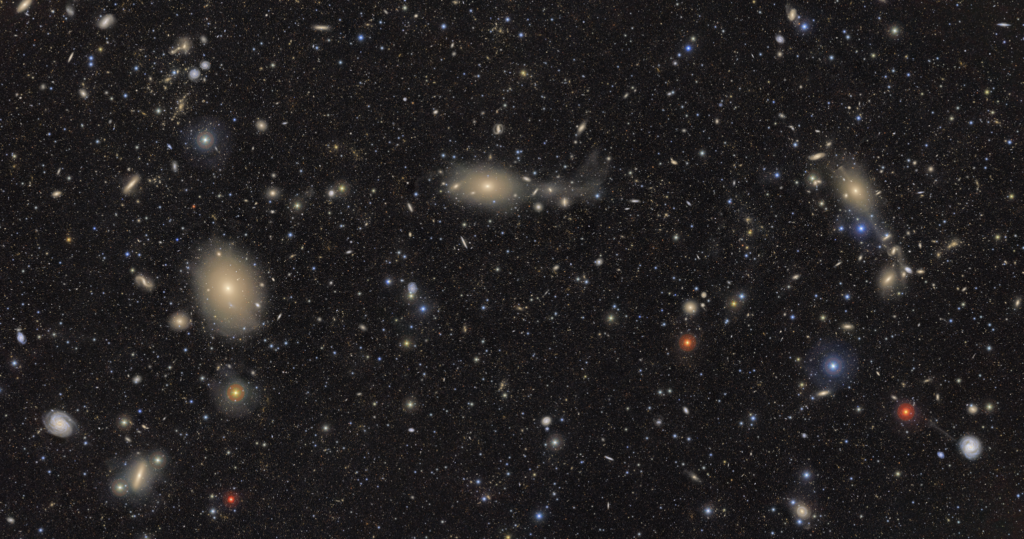
The observable universe is the region of the cosmos from which light has had time to reach us since the universe became transparent (shortly after the Big Bang). It is not “everything that exists,” but “everything we can possibly observe” given the age of the universe and the speed limit set by light.
Here’s the surprising part: the observable universe is much larger than 13.8 billion light-years in radius, even though the universe is about 13.8 billion years old. Why? Because while the light was traveling toward us, the universe itself was expanding, stretching the distance between us and the sources of that light. So the “current distance” to those most distant regions is bigger than the “light travel time” might suggest.
A number you’ll often hear
A commonly cited estimate is that the observable universe is about 93 billion light-years across (diameter). Don’t worry about remembering it perfectly. The important intuition is: our observable region is tens of billions of light-years wide, and it’s defined by horizons and expansion, not by a physical edge like a wall.
The universe has no “edge” we can point to
When people imagine the universe’s boundary, they often picture a hard border: a place where you could arrive and press your hand against the “end.” Modern cosmology doesn’t really work that way. The observable universe has a boundary in the sense that beyond it, light hasn’t reached us yet. But that boundary is a limit to information, not necessarily a limit to existence.
The best analogy is a horizon at sea. Standing on a beach, you can see out to a line where the ocean meets the sky. That line is real in the sense that it marks what you can observe, but it’s not an edge of the ocean. It’s an edge of your viewpoint.
Expansion: the reason “size” is a moving target
The universe is expanding, meaning that on the largest scales, galaxies are (on average) moving away from one another as space itself stretches. This doesn’t mean galaxies are flying through space like shrapnel from an explosion; it’s closer to the idea that the grid between galaxies is being stretched.
How can something expand without expanding “into” anything?
This is one of the strangest ideas to internalize. Expansion doesn’t require an external empty room the universe is growing into. In cosmology, “space” is part of the system. It’s the ruler that changes. Asking what the universe expands into can be like asking what direction is “north of the North Pole.” The question assumes a framework that may not apply.
Expansion is also why the farthest observable regions can be extremely distant today, even if the light started its journey when the universe was much smaller. In a sense, the universe has been enlarging the map while the postcard was in the mail.
The size of the whole universe: what we know (and don’t)
Could the universe be infinite? Possibly. Could it be finite but unbounded, like the surface of a sphere (but in 3D, not 2D)? Also possible. Observations suggest that space is very close to “flat” on large scales, which is compatible with an infinite universe, but it could also be a finite universe so large that our observable patch can’t detect the curvature.
In practical terms, the observable universe is the part we can measure directly. Beyond that, we rely on models and indirect clues. Many cosmologists think the universe could be vastly larger than what we can see—potentially by factors that make 93 billion light-years look modest.
Big numbers with meaning: galaxies, stars, and emptiness
Size isn’t just a diameter; it’s also what’s in the volume. The observable universe contains an enormous number of galaxies, and each galaxy contains a staggering number of stars. Yet, paradoxically, the universe is mostly empty space. Even in a galaxy, the typical distance between stars is so vast that if the Sun were the size of a grapefruit, the nearest star would still be hundreds of kilometers away.
The cosmic web
On the grandest scales, matter isn’t spread evenly. Galaxies cluster along filaments and sheets, with huge voids between them, forming a “cosmic web.” This structure is a reminder that cosmic size is also about architecture: the universe is not just big, but patterned.
So, how big is it—really?
If you want the simplest answer that’s still scientifically honest: the observable universe is roughly tens of billions of light-years in radius, and roughly about 93 billion light-years across by common estimates. But the universe as a whole may be far larger—possibly infinite—and we can’t currently measure its full extent.
The deeper answer is that “size” in cosmology comes with footnotes. It depends on what you mean by distance, how you define “now,” and where the limits of observation lie. Still, there’s something wonderfully grounding about the takeaway: we live in a universe where the fastest thing there is—light—has been traveling for nearly the entire age of cosmic history, and even that journey only shows us a portion of what might exist. The universe isn’t just big; it’s big in a way that stretches our intuition, inviting us to keep improving our rulers, our models, and our imagination.